
Micronutrient Testing for Thyroid Health
Micronutrient testing for thyroid health: learn what focused testing can and cannot show, then prepare questions for a thoughtful conversation with your clinician.
Micronutrient testing for thyroid health can be worth discussing when there is a clear question behind the test. Walsh Health Solutions describes its overall Access, Test, Personalize approach, which starts with history before selective testing is considered. But a test is not a universal explanation for thyroid symptoms, and more measurements do not automatically make an assessment more useful. Start by asking what the proposed test measures, why it fits the person's history, and how each possible result could affect the next step.
What does micronutrient testing for thyroid health measure?
Micronutrients are vitamins and minerals the body needs in relatively small amounts. A micronutrient test measures a particular substance in a particular sample with a particular method. The label does not describe one standard panel. Two tests that mention the same nutrient may use different samples or methods and may be intended to answer different questions.
A measurement is a piece of information, not a complete account of nutrition or health. A blood value reflects what the method measures in that sample at that time. It does not automatically tell the whole story about intake, absorption, storage, or how a nutrient is being used. Recent food and supplement intake, timing, health circumstances, and the laboratory method may all affect how a result should be understood.
That is why it helps to ask the clinician to explain the test in ordinary language before agreeing to it. What substance is being measured? What does the sample represent? What are the limits of the result? Is the test designed to answer the question being asked, or is it being used as a broad screen? These questions make it easier to judge whether a proposed test has a practical purpose.
A laboratory report may show a reference interval. That interval is not a stand-alone diagnosis or a promise that a value inside it rules out every concern. A value outside it does not, by itself, prove that a nutrient caused a symptom or that a supplement will resolve a thyroid issue. The clinician needs to consider the reason for the test, the person’s history, and other relevant information.
How can nutrients relate to thyroid health?
Nutrition is one part of the body’s many processes, and some nutrients have roles in normal thyroid function. This general point does not mean that every person with Hashimoto’s or hypothyroidism has a nutrient deficiency. It also does not mean that every person with a thyroid concern needs micronutrient testing, or that taking more of a nutrient is always helpful.
Iodine is needed to make thyroid hormones. A research record describes how inadequate iodine intake can impair thyroid function and lead to a range of disorders. That information is about a general biological role; it is not proof that a particular person has low iodine, that iodine explains their symptoms, or that they should take a supplement. Read the research record on micronutrient deficiencies and iodine. Do not begin high-dose iodine based on a symptom list or a general article. Discuss any supplement with a qualified healthcare professional, particularly if thyroid care is already underway.
Specific examples show why the sample and method matter. Ferritin is a blood marker related to stored iron, but an elevated ferritin result can have causes other than excess iron, including inflammation, so it should not be read in isolation. MedlinePlus explains the ferritin blood test. For vitamin D status, clinicians commonly discuss a serum 25-hydroxyvitamin D measurement; the NIH notes that assay variation affects interpretation and that the 1,25-dihydroxy form is generally not a good indicator of vitamin D status. See the NIH vitamin D fact sheet. Selenium also has a role in thyroid gland function, but the NIH notes that more research is needed about selenium and thyroid disease. See the NIH selenium fact sheet. These examples do not establish which, if any, test belongs in an individual assessment.
People may ask about nutrient testing when they are dealing with fatigue, changes in weight, brain fog, or other concerns. Those experiences can have more than one explanation. A micronutrient result can provide information about the specific measurement, but it cannot independently identify the cause of those experiences. It should not replace a broader review of thyroid history and existing care.
It is also useful to separate a nutrient’s biological role from a personal diagnosis. “This nutrient is involved in normal thyroid function” is not the same as “this person has too little of it.” The first is general knowledge. The second requires an individualized assessment, and a test may or may not be the right way to investigate it. Ask the clinician to make that distinction clear.
When is micronutrient testing for thyroid health worth discussing?
Begin with a specific question: what are you trying to learn, and what decision could the answer inform? Testing may be worth discussing when a particular part of someone’s diet or health history raises a concern, when an earlier result needs review, or when a clinician explains why a specific measurement fits the situation. These are reasons to talk about testing, not proof that a test is necessary.
Imagine that a previous report showed a value outside the laboratory’s reference interval. Before starting a supplement, ask whether the result is current, whether the sample and method fit the question, and what other context may matter. Then ask whether a new measurement, review of the original result, or some other assessment could make the picture clearer. Most important, ask what a low, high, or in-range result would change. If the next step would be the same whatever the number, ask what additional value the test is expected to provide.
Now consider someone who takes several supplements and wonders whether any could affect testing. A useful first step is to list every product, its ingredients, the amount taken, and how often it is used. Bring the containers or clear photographs of labels if possible. The clinician can decide whether any item affects test selection or timing. Do not stop prescribed medicine or change a supplement schedule to prepare unless a clinician who knows the situation advises it.
A third example is a person who has changed their eating pattern or avoids certain foods and wonders whether that matters. Write down what changed and when, without assuming that the change proves a deficiency. Share the information during the discussion. It can help the clinician decide whether the history supports a focused question, whether more context is needed, or whether testing is not the most useful next step.
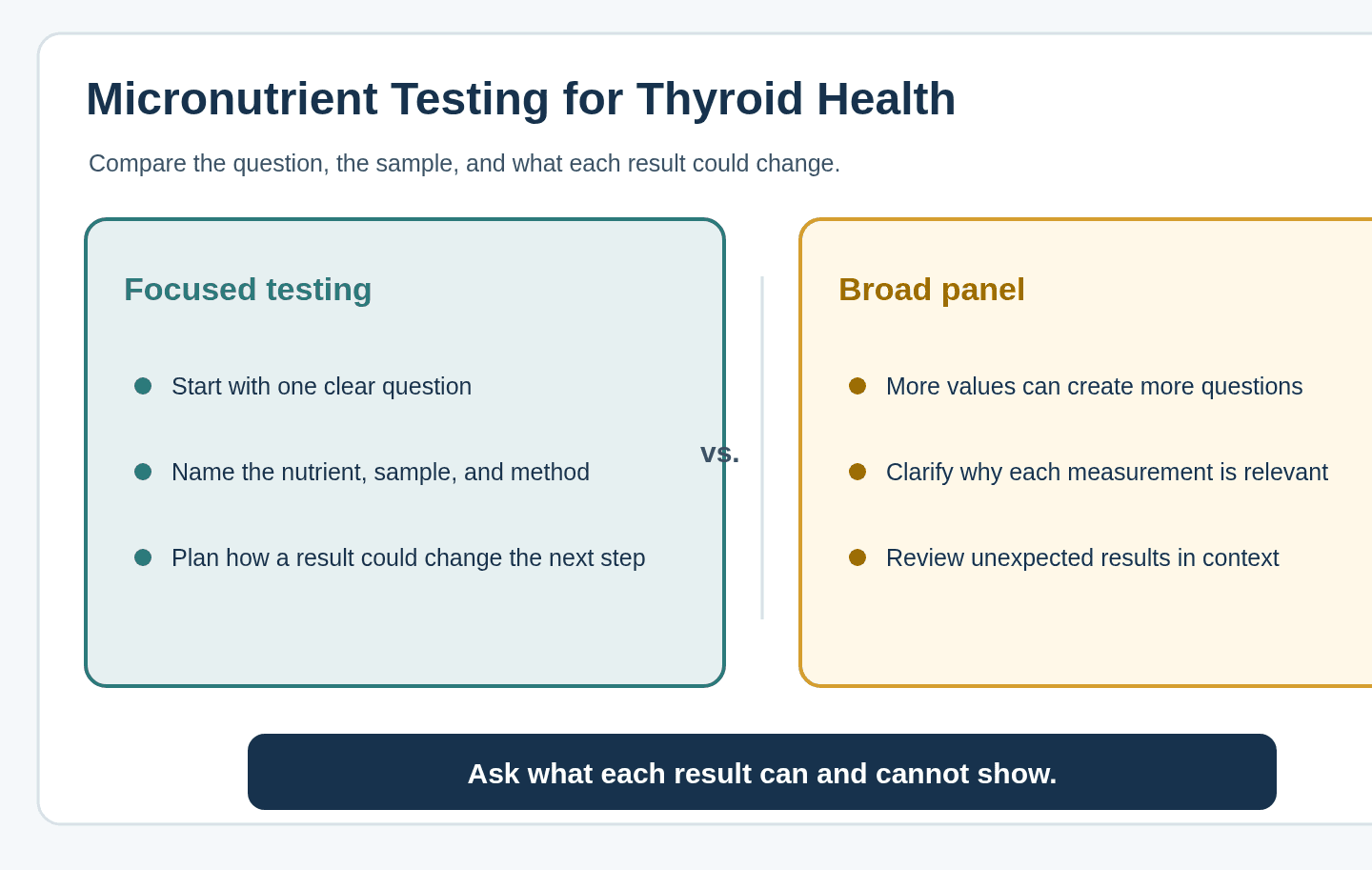
A broad panel can sound more complete than one focused measurement. Yet each added measurement may also create a new interpretation question. Ask which nutrients are included, why each one is relevant to the history, and whether a narrower approach could answer the same question. The goal is not to collect the largest number of results. The goal is to obtain information that can be understood and used responsibly.
What should you ask before agreeing to testing?
Before a sample is collected, make sure the proposed plan is clear. You can use these questions as a practical checklist:
- What specific nutrient or health question are we evaluating?
- Why is this test a fit for my history and current concerns?
- What sample will be used, and what does this method measure?
- What can this result tell us, and what can it not tell us?
- Could recent food, supplements, medicines, illness, or timing affect interpretation?
- How might a low, high, or in-range result change the next step?
- Would an unexpected result need confirmation or another kind of assessment?
- Who will explain the report, and when should I expect that discussion?
- What fees may apply to the assessment, test, or follow-up?
These questions are not a challenge to the clinician. They help both sides understand what the test is meant to do. A clear explanation should connect the test to a question and describe how the result will be reviewed. If the answer is unclear, ask for a plain-language explanation or take time to consider the plan.
Preparation instructions depend on the specific test and person. If fasting or another step is needed, ask the ordering office for instructions rather than guessing. Keep the instructions with your appointment notes. Do not stop prescribed treatment, change a dose, or skip a supplement just to influence a result unless the clinician directs you to do so.
It is reasonable to ask about total costs before moving forward. The public information from Walsh Health Solutions does not set out every assessment, laboratory, or follow-up fee. Do not assume that a consultation, test, or follow-up is included or free based on a general label. Confirm the scope and any costs directly before agreeing to a service.
How can you prepare for a useful appointment?
You do not need to arrive with a diagnosis or a list of tests you expect. A short, organized account of what you want to understand can make a conversation more useful. Bring information that shows the sequence of events and what has already been considered.
- Bring available thyroid test reports, including dates, units, and laboratory reference intervals.
- List current and past medicines and supplements, including amounts and how often you take them.
- Note relevant eating patterns, food restrictions, and recent changes without labeling them as a diagnosis.
- Bring earlier nutrient reports and any follow-up recommendations.
- Write down your main question and what decision you hope the discussion will clarify.
- Note any preparation instructions or expected fee you have been given.
The original report is more useful than a remembered number. A value without its date, units, and reference interval may be difficult to interpret. If you cannot find a report, say so. Missing paperwork is not a reason to postpone routine care. Ask whether the clinician can obtain the report or whether a new test is appropriate.
Try to separate observations from conclusions. For example, note when a concern began, what changed around that time, and what care or testing has already occurred. Instead of writing “I know this nutrient is the cause,” write “I would like to understand whether this result could be relevant.” That wording leaves room to consider more than one explanation.
A simple timeline can help. Include the approximate date a concern began, any major changes in diet or supplements, prior test dates, and conversations about thyroid care. The timeline does not need to be perfect. It is a memory aid, not a substitute for records or a clinical evaluation. If several events happened at once, say that rather than trying to decide which one caused the change.
Bring questions in priority order. If time is limited, start with the question that matters most: whether a proposed test is relevant, what the result could change, or how an existing result should be reviewed. Ask who will follow up and how. Before leaving, repeat the plan in your own words so you can check that you understood it.
How does testing fit into a thyroid-health assessment?
Walsh Health Solutions describes its process as Access, Test, Personalize. It begins with a history-first assessment and discussion. Testing may be considered selectively, and next steps are intended to reflect the individual. This does not mean that every assessment includes micronutrient testing or that a particular test or panel is included.
For a micronutrient question, the order of the conversation matters. First, explain what prompted the question and review available history. Next, ask whether a specific test is likely to add information relevant to that question. If testing is considered, clarify what it measures, its limits, and how different results might be used. Then discuss what next steps make sense in the context of the broader assessment. A result should not automatically become a supplement plan.
Walsh Health Solutions’ overview of the Access, Test, Personalize approach describes the process, while its health assessment information provides more detail about the assessment. Use those pages to understand the public description, then ask what applies to your circumstances. They do not establish that a particular nutrient test is necessary for every person.
If a test is proposed, ask how the result will be communicated and who is responsible for reviewing it. Find out whether the review is part of the proposed service or involves a separate step. Ask what happens if the result is unexpected, unclear, or inconsistent with earlier information. These practical details matter because having a report is not the same as having an explanation or a plan.
It is also appropriate to keep the clinician managing ongoing thyroid care informed. A test or supplement suggestion made in one setting should not be acted on in isolation if another professional is responsible for related care. Sharing reports and recommendations can reduce the risk of decisions being made from incomplete information.
What should you know about supplements?
A test result does not automatically mean a supplement is needed. The appropriate response depends on the question, the result, and the full context. More is not always better. Excess intake can cause harm, and some products can interact with medicines or affect later testing. Avoid trying to correct a laboratory number on your own.
Bring the product label or a clear list of ingredients, amounts, and frequency to the discussion. Include over-the-counter products as well as items recommended by another professional. If you are considering starting, stopping, or changing a product, ask how that choice fits with existing care and whether monitoring is appropriate.
Do not stop prescribed thyroid medicine because of a nutrient result or supplement suggestion. A nutrient test does not replace the clinician responsible for ongoing thyroid care. If more than one professional is involved, share relevant results and plans with the care team so decisions are not made from an incomplete record.
Be cautious about claims that a supplement will correct a thyroid problem or resolve a symptom. A general nutrient role does not establish that a product is right for an individual. Ask what the recommendation is based on, what amount and duration are being proposed, what potential risks apply, and how you will know whether the plan should continue. Do not rely on marketing language as a substitute for an individualized discussion.
How should you understand an unexpected result?
If a result is low, high, or surprising, start by asking the clinician who ordered it to explain it. Confirm which test was performed, the reported units and reference interval, and whether preparation or timing could have influenced the sample. Ask whether the result answers the original question or raises a different one.
A value outside a reference interval is not automatically a diagnosis. A value inside it does not answer every health question. Interpretation may depend on the method, sample, timing, relevant history, and other findings. If a report is unclear, ask for a plain-language explanation rather than comparing a number from one laboratory with a number from another without context.
Then ask what action is proposed and why. Is the suggestion to repeat or confirm a measurement, review other information, discuss diet, or take no action for now? What would make the clinician reconsider? A sound explanation should connect the result to a specific decision while acknowledging what remains uncertain. Avoid making major changes to medicines, diet, or supplements based on one number.
For example, suppose a result differs from an older report. Before treating the difference as a meaningful change, ask whether both reports used the same type of test, sample, units, and laboratory method. Ask whether timing, preparation, or recent product use differed. The point is not to dismiss either report; it is to understand whether they can be compared and what conclusion, if any, the clinician thinks is justified.
If a result was ordered outside the clinician managing your thyroid care, share it with that clinician before making changes. Ask who is responsible for follow-up and how you will receive an explanation. Keep a copy of the report and notes from the discussion, especially if more than one test is being considered.
Review the health assessment information if you want to discuss whether a focused micronutrient question fits your history.
How can you compare a focused test with a broader panel?
There is no single best test format for everyone. Comparing options by purpose, interpretation, and cost can clarify what is being proposed. This table is a discussion aid, not a recommendation for a particular test:
| Approach | Question to clarify | What to consider |
|---|---|---|
| One focused measurement | What specific question does this nutrient test address? | It may keep the discussion centered, but still requires context and interpretation. |
| Several selected measurements | Why is each included measurement relevant to the history? | Ask how each result could affect decisions and whether the added information is useful. |
| Broad panel | What will we do differently based on the possible results? | More values can create more questions; clarify limits, follow-up, and total fees first. |
| No testing for now | What supports waiting, and what would prompt reconsideration? | A clear plan can include reviewing the situation later if the question changes. |
The key comparison is not “small versus comprehensive” in the abstract. It is whether the proposed approach has a clear purpose, whether the result can be interpreted meaningfully, and whether there is a reasonable plan for possible outcomes. A clinician should be able to explain why the approach is being considered without promising what it will show.
For a focused measurement, ask how that one result relates to the concern and what other information will be considered alongside it. For several selected measurements, ask the reason for each one rather than accepting a list as a single unexplained package. For a broad panel, ask how results that are unexpected or unrelated to the original question will be handled. In every case, clarify who will review the report and whether follow-up has a separate fee.
Choosing not to test immediately can also be a deliberate decision. Ask what information supports waiting, what changes would prompt another discussion, and whether any existing records should be reviewed first. A decision to wait should not mean ignoring a concern; it can mean agreeing on what to watch, when to check back, and who to contact if the situation changes.
How can you make the appointment conversation concrete?
A useful conversation can follow a simple checklist:
- State the question. Say what you want to understand, such as whether a micronutrient test could add useful information to this thyroid-health discussion. Then give the short version of relevant history, including what prompted the question, what testing has already occurred, and what supplements or medicines are being used.
- Identify the decision. Ask whether the proposed next step is to order a particular test, review an existing report, or wait. Ask what information would support each option.
- Discuss possible outcomes. Ask what an in-range result would mean, what an out-of-range result might lead to, and what would happen if the report were unclear. This sets realistic expectations about what the result can and cannot settle.
- Confirm follow-up. Ask how the result will be delivered, who will interpret it, when to expect a conversation, and whom to contact with questions. If the test is not ordered, ask whether there is another step or a point at which the question should be revisited. Write down the plan while it is fresh.
For instance, a person with an old report and no clear record of the test method could bring the document and ask whether it can be interpreted as it stands. The clinician may want more context before deciding whether another test is useful. That conversation is more informative than asking for “a full nutrient panel” without knowing what the panel includes or how each result would be used.
Another person may have no prior nutrient testing but a specific concern about diet or supplement use. They can explain what prompted the concern and ask whether the history points to a focused question. The clinician may recommend testing, request more information, or decide that testing is not indicated at that time. The important point is that the decision follows from the question and context, not from a general assumption that everyone should be tested.
Frequently asked questions
Does everyone with Hashimoto’s need micronutrient testing?
No single testing plan fits everyone. Whether a test is useful depends on the person’s history and the specific question. Ask why a particular test is being considered and how its result could influence the next step.
Can micronutrient testing explain thyroid symptoms?
A test may provide information about a particular nutrient, but it cannot by itself establish the cause of symptoms. Thyroid concerns and symptoms can have multiple contributing factors, so results need to be considered alongside history and other relevant information.
Should I take iodine before testing?
Do not begin high-dose iodine or another supplement to address a thyroid concern without professional guidance. Tell the clinician what you already take and ask whether it could affect testing or interpretation.
Will a health assessment include micronutrient tests?
Not necessarily. Walsh Health Solutions describes testing as selective and based on the individual discussion. Confirm what the assessment includes, whether a test is being proposed separately, and what costs may apply before proceeding.
Should I stop medicine or supplements before a test?
Do not stop prescribed medicine or change a supplement routine to prepare unless the clinician ordering the test gives instructions. Preparation depends on the specific test and the person’s circumstances. Ask the ordering office what to do and share a complete list of products you take.
Call to discuss a health assessment
A practical next step
Micronutrient testing is most useful to discuss when it addresses a specific question and there is a plan to interpret the result in context. Write down what you want to understand, gather available records, and ask about the test’s purpose, limits, and cost. For a direct conversation, call Walsh Health Solutions at (785) 272-3700 or use the contact page. Keep your usual care team informed about testing or supplement decisions, and ask for help interpreting results before changing your care.